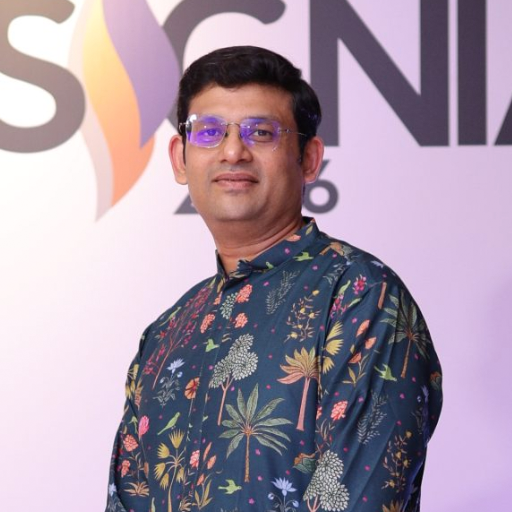
Mr. Kanak Gupta
Director, Seth M. R. Jaipuria Schools
“AI is the great equaliser — it does not look at the pin code.”On AI equity
Session recap
“We Heard You”: a candid open house with the chairpersons
Mr. Kanak Gupta's "We Heard You" session was built as an open house — a locked box of curated questions he had not seen, with the floor invited to push back. He began with the one thing he felt the corporate office needed to get better at: prioritisation. Schooling is now 365 days, 24x7; the corporate office runs about sixteen events, and too often it assumes that once a plan is made, everyone understood. Better, more transparent communication alongside sharper prioritisation would move schools and corporate toward the same results.
The questions from the floor were the real content. On spoken English in catchment areas where the home environment does not support it, he was candid that AI will democratise access — pointing to Rehearsal Junior — and unapologetic about Indian-accented English, recalling his London keynote and the double standard that celebrates French and German accents while Indians pull down their own. He took a request for promoter-focused workshops modelled on Jagriti, and committed to planning one within six months, alongside the Promoter Toolkit.
He reported progress on what the room had already asked for. A J-Learn management dashboard for promoters — so they can see teacher usage, course completion and lesson-plan adoption — had shipped that week, with usernames and passwords sent. On books, he gave hard commitments: the book list would reach schools by 1 October, with stock ready by 15 October, improving year on year. On curriculum consistency and undeclared holidays, he acknowledged the gap and pointed to Jaipuria Edge, city-level calendar improvement, and the NEP move from horizontal coverage toward vertical depth.
“AI is the great equaliser. It does not look at the pin code at all — and our students in Ayodhya, Gorakhpur or Jhansi may outdo the big cities.”
On AI reaching every student, he outlined QR codes across books, diaries and online presence for tools spanning communication, problem-solving and question-paper generation, with AI elements woven into all sixteen events and parent workshops. Asked whether some schools are now ahead of corporate on AI, he embraced it: AI is the great equaliser that ignores pin codes, and corporate should learn from the schools. A best-practices board and a principals' WhatsApp group were set up to make that exchange formal.
The session's most personal exchange was on values and nation-building — a promoter's worry about corruption and whether Jaipuria is instilling honesty and patriotism. He was bullish on India, pointed to students who greet with Vande Mataram, to the SPICE values (I for Integrity), and to the reflection chronicle on Panchkosh Vikas that goes to every child from grade 3 up, with positive feedback documented across schools. He even changed his mind on one piece of promoter criticism: corporate presence at marquee events like annual days matters more than he once thought.
He closed the way he opened — with humility. Promoters raised real operational pain: heavy school bags, the need for a centralised teacher-recruitment mechanism with transfers and checks, and what an "ideal school" looks like. He took each one — supervising timetables and bag weight, JGrow's AI-empowered recruitment, and the honest answer that the sixty-two schools in the room are themselves the ideal, each unique — and left the room with the long view: school is a long-term play; give it ten to fifteen years.
Editorial summary compiled by the LDP team — not a verbatim transcript. Spotted an inaccuracy? Let us know.
Watch the Open House discussion — Kanak Gupta, Day 1 of INSIGNIA 2026.
Key takeaways
- 1
Prioritise and communicate transparently
Plans fail when corporate assumes everyone understood. Sharper prioritisation and open, transparent communication close the gap between what schools want and what the corporate office wants.
- 2
Use AI to level the field
Rehearsal Junior and AI tools democratise spoken English and learning regardless of a city's catchment or pin code. Aspiration in tier-2 and tier-3 towns can outpace the metros.
- 3
Make commitments with dates
The J-Learn management dashboard shipped, book lists were locked to 1 October and stock to 15 October. Concrete deadlines, improving year on year, beat repeated reassurances.
- 4
Let the schools teach the corporate office
Set up best-practice exchanges — a board in the room, a principals' WhatsApp group — so innovation flows from the ground up rather than only from Delhi.
- 5
Instil values through structure, not slogans
SPICE values, the reflection chronicle on Panchkosh Vikas from grade 3 up, and a culture where children say Vande Mataram build character measurably, with case studies to prove it.
- 6
Build for the long term
Recruitment, bag weight, an “ideal school” — each is a long-term play that rewards patience over years, not quarters. The sixty-two schools in the room are themselves the ideal.
What he spoke on
- Prioritisation and transparent communication between corporate and schools
- Spoken English, Indian accents and AI democratisation (Rehearsal Junior)
- The J-Learn management dashboard for promoters
- Books timeline — book list by 1 October, stock by 15 October
- Curriculum consistency, undeclared holidays and NEP's vertical depth
- AI in curriculum, QR-coded access and parent workshops
- AI as the great equaliser across tier-2 and tier-3 cities
- Best-practice exchange across the network
- Values, patriotism and the reflection chronicle (Panchkosh Vikas)
- Corporate presence at marquee events, bag weight and centralised recruitment
Q&A captured
Q. How do we make sure AI actually reaches every student?
AI elements run through all sixteen network events and parent workshops; QR codes on books, diaries and the online presence give students, parents and teachers direct access to tools for communication, problem-solving and question-paper generation.
Q. Are some schools already ahead of the corporate office on AI?
Likely yes — and that is healthy. AI ignores pin codes, so a school in Ayodhya, Gorakhpur or Jhansi can out-innovate a metro. The aim is for corporate to learn from the schools, which is why a best-practices exchange and a principals' WhatsApp group were set up.
Q. What about teacher recruitment — can it be centralised?
JGrow now screens teachers through AI, building an objective, updated database matched to vacancies, with profiling improving. It is not instant, but the feedback is taken — good teachers can come from anywhere, and upskilling continues four times a year alongside online and AI-enabled courses.