
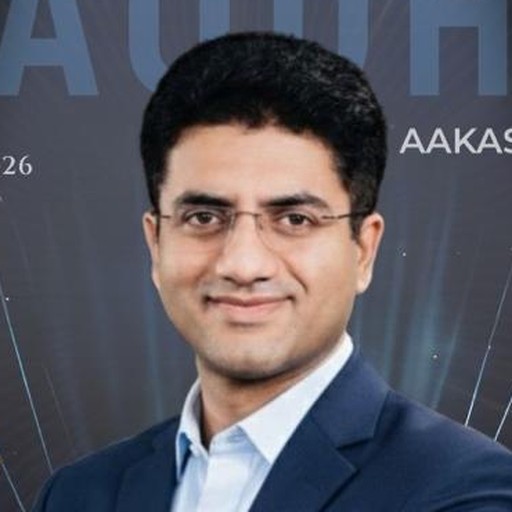
Mr. Aakash Chaudhry
Founder, Aakash Educational Services & Sparkle Edventure
“Standardise your promise, localise your expression.”On quality at scale
Session recap
Growth by design: lessons on scale, systems and quality
Mr. Aakash Chaudhry sat down with Mr. Shreevats Jaipuria for a fireside chat on building sustainable growth — the story of how Aakash Educational Services went from 30 centres and ₹35 crore in revenue to 350 centres and ₹2,200 crore in fourteen years, and the principles that made it possible.
He began with the decision that shaped everything else. When he joined the family business in 2006, his father refused to let him work from the head office. **"If you stay with me, you won't learn."** So he spent three years running a franchise in Bombay — making mistakes, understanding academics, operations, marketing, sales, infrastructure — before he was allowed to join the corporate journey in Delhi. That franchise apprenticeship, he said, was the single most valuable experience of his career, because it taught him the value, care, economics and accountability that keep a brand's stature intact.
From there he distilled the three decisions that drove the company's rise. **First, fanatical focus on outcomes.** In education, the result is everything: if parents do not see results, trust breaks. "If there is result, then there is revenue; if there is revenue, then there is better quality — and the cycle continues." **Second, systems.** A good system lifts the floor; it ensures the same quality teacher follows the same syllabus, timetable and question paper whether the centre is in Delhi, Gulbarga, Calcutta or Assam. **Third, talented people.** Good people lift the ceiling. "You need both — systems can lift your bottom, but people can pull from the top."
“Standardise your promise, localise your expression. If a parent in Panipat can't get the same outcome as one in Delhi, the story falls apart.”
On the question that haunted every education entrepreneur in the room — can quality and scale coexist? — he was unequivocal. "We were able to maintain quality because of scale." Scale is the enemy only when you scale the wrong things. Scale the right quality elements and scale becomes the greatest multiplier of quality there is, because it gives you the investment capability to pour back into teachers, training and technology. His Harvard professor put it simply: **"Just focus on excellence. Where there is excellence, it will scale on its own."**
Standardisation versus customisation drew a sharp line. **"Standardise your promise, localise your expression."** The promise — what parents trust the brand to deliver — must be identical everywhere. How you teach, the language you use, the examples you pick, can and should be local. But if a parent in Panipat cannot get the same outcome as one in Delhi, the story falls apart. That belief drove the largest teacher-training, hiring and placement mechanism in Indian coaching, and he was unapologetic about the spend: "What if I spend on training and people leave? What if I don't spend — and people stay?"
On delegation he reached for Akbar's Navratans. Akbar was great not because he did everything himself but because he had a thinker, a singer, a fighter. Aakash's method: list the work that should happen without you, cluster it — technology, sales, academy — and delegate it, while keeping purpose, culture and trust firmly with the owner, because "that thinking cannot be done professionally." The first CEO experiment failed because he skipped the hand-holding; the team needed to see that the owner stood behind the change. The second time he was present in every meeting until the new leader was accepted.
The conversation turned personal on family business. He joined twice — first at 21, when his father was at the peak of teacher stardom and rejected every idea; then again in 2006, when his father told him, **"You are coming back not to change me — use me. Use my experience, don't disrespect it."** His advice to the next generation: understand the old way first, respect it, then bring your data and technology. "Experience and data, insights and technology — when they work together, they create magic. Neither alone is enough."
He closed with crisis composure. When 16 of 20 teachers were poached overnight in Kota, he didn't panic — he called six centres, filled the first flight with replacements, and ran the timetable the next morning. "The problem comes, the problem stays, and then the problem leaves. You don't go around it — you jump in the middle of it, fix it and come out."
Editorial summary compiled by the LDP team — not a verbatim transcript. Spotted an inaccuracy? Let us know.
Watch the fireside chat — Aakash Chaudhry with Shreevats Jaipuria, Day 1 of INSIGNIA 2026.
Key takeaways
- 1
Focus on outcomes above everything
In education, results are the foundation of trust. If parents see results, revenue follows; revenue funds better teachers, systems and technology, which produce better results. Break that loop and the business hollows out.
- 2
Systems lift the floor, people lift the ceiling
A strong system guarantees a minimum quality everywhere — same syllabus, timetable, question paper and outcome whether the centre is in Delhi or Assam. Talented people push the top. You need both; either alone stalls growth.
- 3
Scale is a multiplier of quality, not its enemy
Scale becomes the enemy only when you scale the wrong things. Scale the right quality elements and it gives you the investment capability to pour back into teachers, training and technology — the greatest multiplier there is.
- 4
Standardise the promise, localise the expression
What parents trust the brand to deliver must be identical in every location. How you teach — language, examples, setting — can and should be local. A promise broken locally breaks the whole brand.
- 5
Invest in teacher training without fear
Spending on training is not wasted when people leave; it is wasted when untrained people stay. Train people so well that if they leave and return, they choose to come back.
- 6
Delegate the work, keep the purpose
Cluster operational work — technology, sales, academy — and hand it to talented people. But keep culture, purpose and trust with the owner. When bringing in a new leader, be present in every meeting until the team accepts the change.
- 7
Two generations: respect before reform
The next generation should understand and respect the founder's experience before proposing change. Bring data and technology alongside experience and insights — together they create magic; either alone falls short.
- 8
Jump into the middle of a crisis
Problems come, stay, and leave. Don't go around them — go through them with a cool mind. The methods you learn in one crisis become the playbook for every crisis after.
What he spoke on
- From 30 centres to 350 — the fourteen-year growth journey
- Why running a franchise first was the best apprenticeship
- Three decisions that drove scale: outcomes, systems, people
- Quality and scale as friends, not enemies
- Standardise the promise, localise the expression
- Investing fearlessly in teacher training
- Delegation and finding your Navratans
- Working in a family business — respecting the first generation
- Crisis composure: the Kota teacher-poaching story
- Vocational education and the future of schooling
Q&A captured
Q. How do you stay calm when something catastrophic happens, like teachers being poached overnight?
It comes from having been through it before. The first time teachers left my Bombay franchise, I had to teach physics myself from a textbook. That taught me the mechanism: the problem comes, it stays, and then it leaves. You don't go around it — you jump in the middle, fix it and come out. Once you've handled it once, the next time you know the method.
Q. How do you handle conflict between experienced old-timers and new hires you bring in to lead?
Role clarity is everything. Give both sides a clear mirror of their skills and their role. Show the team that you stand behind the new person — be present in meetings until the change is accepted. Sometimes you 'park' a respected old-timer in a role like chairman's office so the new leader has space, then bring them back to contribute once the dust settles.
Q. What about schools — should we be adding vocational and skill-based learning?
This question will haunt every school in the next five years. Degrees alone are no longer guaranteeing jobs. CBSE has already made vocational programs available — hydroponics, mechanics, carpentry, agriculture — that can be inducted into the curriculum. But as an entrepreneur, you don't have to wait: you can bring vocational opportunities to your school after 2 pm. Nobody is stopping you.